Khi nói về tiếng Nhật, chúng ta thường nghĩ ngay đến cấu trúc sắp xếp câu chữ “ngược ngạo” SOV (Subject-Object-Verb) thay vì cấu trúc quen thuộc SVO như rất nhiều loại ngôn ngữ phổ biến khác trên thế giới như tiếng Anh, tiếng Trung, tiếng Pháp, tiếng Thái hay cả như tiếng Việt của chúng ta.
Ví dụ, người Nhật sẽ nói câu “Tôi
đã ăn
một trái táo” thành “Tôi
trái táo
đã ăn”
Phiên dịch ra thì sẽ nghe như kiểu "Watashi wa ringo o tabemashita" (私はりんごを食べました) - "I ate an apple."
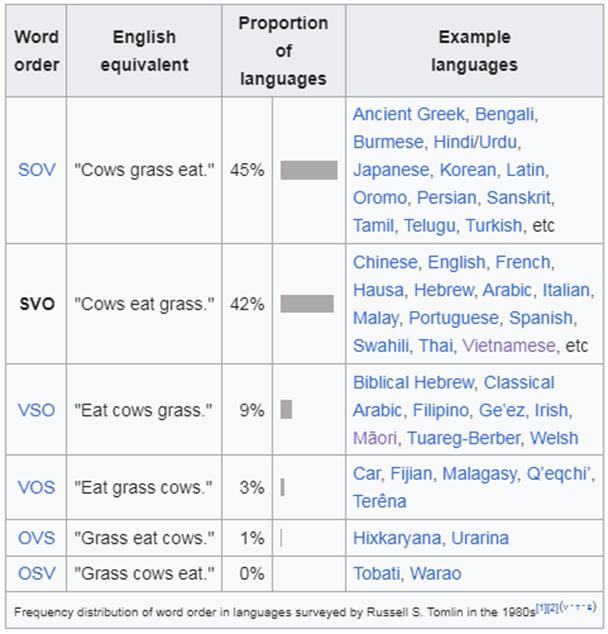
Theo như khoa học nghiên cứu về các loại hình ngôn ngữ (linguistic typology) thì chỉ riêng hai loại SVO và SOV đã chiếm đến 87% cấu trúc ngôn ngữ toàn thế giới.
Theo thống kê từ Wikipedia từ những năm 1980 thì đây là sơ đồ phân chia hàng loạt những cấu trúc ngôn ngữ khác nhau nhằm miêu tả đúng cho một ý tưởng. Nếu lấy ví dụ một câu nói đơn giản “Bò ăn cỏ” (Cows eat grass) thì đây là số cấu trúc có thể xảy ra:
Đặc điểm dễ nhận ra tiếp theo đó là phong cách không nói rõ chủ thể mà chỉ nói những “keyword” cần thiết. Nói cách khác, nếu chỉ dịch thô những âm tiết mà người Nhật nói ta sẽ nhận ra ngay phong cách đặc trưng “chỉ nói lấp lửng một nửa” để người nghe tự đoán ra ý mình của dân xứ hoa anh đào. Đặc điểm này vừa là một điều rất thú vị trong văn hoá giao tiếp được cho là văn minh tinh tế của người Nhật Bản và vừa là một điểm trừ to lớn cũng chính do truyền thống lấp lửng giữ kẽ lịch sự tinh tế quý-sờ-tộc có phần hơi quá này.
Dưới góc nhìn của CHUNKS, sau đây là 7 tình huống cơ bản mà có lẽ bất cứ ai vừa học tiếp cận một loại ngôn ngữ mới cũng đều nên biết. Nắm được 7 kiểu tình huống này hẳn là bạn đã có thể “survive” được khi đi du lịch 4 ngày 3 đêm sang quốc gia tương ứng.
I. Tình huống 1: Hi
| |
|---|
こんにちは (Konnichiwa)
こんにちは (Konnichiwa)こんにち (Konnichi) - This means "today" or "this day."は (wa) - A particle used to mark the topic of the sentence. It follows こんにちは to form the greeting. --------------------------- Today - the (subject) | |
やあ、そこ(Yā, Soko)
やあ (Yā) - This is an informal greeting similar to "hi" or "hey."
そこ (Soko) - This means "there." It's used to refer to the location of the person you're greeting.
-----------------------------
Hi - there | |
どうですか?(Do desu ka?)
"Do" (どう): means "how."
"Desu" (です): is a polite copula verb in Japanese, often translated as "is" or "are."
"Ka" (か): is a question marker, indicating that the sentence is a question.
-------------------------------
How - be - ? = How - right? | How’s it going? / how is it? / how's about it? |
"どうしたの?" (doushita no?) or "どうしたか?" (doushita ka?)
"どうした (doushita)" means "what's up" or "what happened." It's formed from:
"どう (dou)" - means "how" or "what"
"した (shita)" - is the past tense of the verb "する (suru)," which means "to do."
"の (no)" is a particle used to turn a sentence into a question or to indicate an explanatory tone and more casual than か (ka)
-----------------------------
How - do? | |
Genki desu ka?
"Genki" (元気) means "healthy" or "fine."
"Ogenki" (お元気) is a polite form of "genki."
"Desu ka" (ですか) is a polite question marker, similar to asking "is it?" or "are you?"
--------------------------
O-Fine - right? [right? = desu ka?] | |
久しぶりですね (Hisashiburi desu ne)
久しぶり (Hisashiburi): "long time no see"
です (desu): is (polite form)
ね (ne): sentence-ending particle indicating agreement or seeking confirmation
---------------------------
Long - time - nhỉ [nhỉ = desu ne] | Such a long time! (Long time no see) |
Hajime mashite
"Hajime" (はじめ) - "Beginning" or "start"
"Mashite" (まして) - A form of the verb "mawasu," which means "to meet"
--------------------------
Start - meet | |
Ya, choshi wa do?
"Ya" (や) - Informal particle used to get someone's attention or start a conversation.
"Choshi" (調子) - Condition, state, or health.
"Wa" (は) - Topic marker particle.
"Do" (ど) - How.
-------------------------
Hey - condition - the - how? | Hey, how’s everything? / how is your condition? / how are you? |
おはよう (Ohayou): "Good morning"
It's a casual way of greeting someone in the morning in Japanese.
お (o): A prefix that adds politeness or respect.
はよう (hayou): The word for "morning."
----------------------------
O-morning | |
"Kyo wa do desuka?"
"Kyo" (今日) means "today."
"Wa" (は) is a topic marker indicating "today" is the topic of the sentence.
"Do" (どう) means "how" or "in what way."
"Desuka" (ですか) is a polite question marker, making the sentence a question.
-----------------------------
Today - the - how - right? | |
"Sumimasen ga" (すみませんが).
"Sumimasen" (すみません) means "excuse me" or "I'm sorry."
"Ga" (が) is a conjunction that roughly translates to "but" or "however."
----------------------------
Sorry - but
| Sorry/Excuse me (interrupt) |
"Onamae wa?" (お名前は?)
"namae" (名前) means "name."
お (o): A prefix that adds politeness or respect.
"Wa" (は) is a topic marker particle indicating the subject of the sentence.
---------------------------
O-Name - the? | |
"Onamae wa shitemo i desu ka?" (お名前はしてもいいですか?)
"namae" (名前) means "name."
お (o): A prefix that adds politeness or respect.
"Wa" (は) is a topic marker particle indicating the subject of the sentence.
"Shitemo" (しても) is a compound word composed of:
"Shite" (して), the te-form of the verb "suru" (する), meaning "to do."
"Mo" (も), which means "even if" or "though."
"i desu ka" (いいですか) means "is it okay?" or "good, right?"
------------------------------
O-name - the - if do - good - right?
| May I know/
ask your name? |
"Doko kara kimashita ka?" (どこから来ましたか?)
"Doko" (どこ) means "where."
"Kara" (から) means "from" or "since."
"Kimashita" (来ました) is the past tense of the verb "kimasu" (来る), meaning "to come."
"Ka" (か) is a question marker.
-----------------------------
where - from - came - ? | |
"Oshigoto wa?" (お仕事は?)
"Oshigoto" (お仕事) means "job" or "work."
"Wa" (は) is a topic marker, indicating the subject of the sentence.
-----------------------------
O-job - the? | |
II. Tình huống 2a: Thanks
| |
|---|
"arigatou" (ありがとう)
"Ari" (有り): Means "existence" or "to be."
"Gatou" (かとう): Derived from the verb "kata" (かた) which means "to give or bestow." However, in this context, it is conjugated as "kata" (かたう) to express gratitude.
"Gozaimasu" (ございます) is a polite suffix that adds formality and respect to the expression "arigatou" (ありがとう).
-----------------------------
Existence - bestow - nhé [Gozaimasu = nhé] | |
"Domo arigato" (どうもありがとう)
"Domo" (どうも) is an adverb meaning "very" or "very much."
"Domo" is a versatile Japanese word that can convey various meanings depending on the context. It can express thanks, apology, or acknowledgment, among other things.
"Arigato" (ありがとう) is the Japanese word for "thank you."
--------------------------------
OMG - thank | Thanks a lot /
thanks a million! |
"Domo arigato gozaimasu" (どうもありがとうございます)
"Domo" (どうも) means "very" or "very much."
"Arigato" (ありがとう) is "thank you."
"Gozaimasu" (ございます) is a polite verb ending that adds formality and respect.
---------------------------
OMG - thank - nhé | |
"Kansha shiteimasu" (感謝しています) is a polite way of expressing gratitude or saying "I am thankful" in Japanese.
"Kansha" (感謝) means "gratitude" or "thanks."
"Shiteimasu" (しています) is the present continuous form of the verb "suru," which means "to do." In this context, it expresses the ongoing action of feeling thankful.
--------------------------
Appreciate - doing | |
"Honto ni arigato" (本当にありがとう) means "Thank you very much" or "I really appreciate it" in Japanese.
"Honto ni" (本当に) means "really" or "truly."
"Arigato" (ありがとう) means "thank you."
--------------------------
Really - thank | |
"Iro iro arigato" (いろいろありがとう) means "Thank you for everything" or "Thanks for everything" in Japanese.
"Iro iro" (いろいろ) means "various" or "different."
"Arigato" (ありがとう) means "thank you."
-------------------------
Various - thank | |
Hajime mashite
"Hajime" (はじめ) - "Beginning" or "start"
"Mashite" (まして) - A form of the verb "mawasu," which means "to meet"
--------------------------
Start - meet | |
"Shinsetsu ne!" (親切ね!) is a Japanese phrase that can be translated as "You're kind!" or "How kind of you!" in English.
"Shinsetsu" (親切) means "kind" or "thoughtful."
"Ne" (ね) is a particle used to seek agreement or emphasize a statement, similar to "isn't it?" or "right?" in English.
---------------------------
Kind - uhm | You are so kind! |
"Kamisama ni negai o" (神様に願いを) is a Japanese phrase that translates to "A wish to God" or "A prayer to God" in English.
"Kamisama" (神様) means "God" or "deity."
"Ni" (に) is a particle indicating direction or recipient.
"Negai" (願い) means "wish" or "desire."
"O" (を) is a particle marking the direct object of a verb.
----------------------------
God - to - wish | |
Tình huống 2b: Responses
| |
|---|
"Ie, tondemonai" (いえ、とんでもない) is a Japanese phrase that translates to "No, not at all" or "No, it's nothing" in English.
"Ie" (いえ) means "no" or "not at all."
"Tondemonai" (とんでもない) means "unthinkable," "absurd," or "outrageous." Here, it's used in a negative context to mean "not at all."
"Ton" (とん) is a colloquial abbreviation of "tondemo" (とんでも), which means "unthinkable" or "absurd."
"Demo" (で) is a particle that emphasizes the preceding word.
"Nai" (ない) is the negative form of the verb "aru" (ある), meaning "to be" or "to exist."
--------------------------
NOOO - no way | You’re welcome! /
It's nothing |
"Do ita shi masite" (どういたしまして) is a polite Japanese phrase used to respond to expressions of gratitude, similar to "You're welcome"
"Do" (どう) means "how" or "what"
"Ita shi" (いたし) is a humble form of the verb "suru" (する), which means "to do."
"Masite" (まして) is the te-form of the verb "mashimasu" (します), which is a polite form of the verb "suru" (する), meaning "to do."
-------------------------------------
What - just do - did (I did what I did/could) | My pleasure /
I did what I could |
"Shin bai si nai de" (心配しないで) is a Japanese phrase that translates to "Don't worry" or "Don't be anxious" in English.
"Shin bai" (心配) means "worry" or "anxiety."
"Si nai" (しない) is the negative form of the verb "suru" (する), which means "to do."
"De" (で) is a particle used to indicate a reason or cause.
So, the phrase literally means "Don't do worry," but it's used to reassure someone not to be concerned.
--------------------------------
worry - not do (don't) - (soften) | |
"Daijoubu" (大丈夫) is a Japanese phrase that translates to "It's okay" or "No problem" in English.
"Daijou" (大丈) means "great" or "big."
"Bu" (夫) means "husband" or "man," but in this context, it's used to negate the previous word, so "daijoubu" as a whole means "not big" or "not a problem."
--------------------------------
Big - not | |
The phrase "Do ita shi masite" (どういたしまして) is a polite way to say "You're welcome" or "Don't mention it" in Japanese.
"Do" (どう) means "how."
"Ita" (いた) is the past tense of the verb "iru" (います), which means "to be" or "to exist."
"Shi" (し) is a linking particle.
"Masite" (まして) is the polite form of the verb "masu" (ます), which is used to show respect or politeness. | You’re welcome/
my pleasure |
III. Tình huống 3: Compliment
| |
|---|
"Sugoi" (すごい) / "Subarashi" (素晴らしい) in Japanese is an exclamation used to express admiration, excitement, or amazement. It can be translated to English as "amazing," "awesome," "incredible," or "fantastic." | |
"Kampeki" (完璧) means "perfect" or "flawless" in English. It's often used to describe something that is impeccably done or meets the highest standards. | |
"Ī ne" (いいね)
"Ī" (いい): This word means "good" or "nice."
"Ne" (ね): This is a particle used at the end of sentences to seek agreement or confirmation, similar to "right?" or "isn't it?" in English.
--------------------------------
good - uhm | Well done / Good job / Great job / keep it up! = you rock! |
"Anata wa saiko desu" (あなたは最高です):
"Anata" (あなた): This is a pronoun meaning "you."
"wa" (は): This is a particle that marks the topic of the sentence, indicating that the topic is "you."
"saiko" (最高): This is an adjective meaning "the best" or "supreme."
"desu" (です): This is a copula verb used to indicate politeness and formality. It corresponds to "is" in English.
---------------------------
You - the best - be | |
"Omedeto" (おめでとう) is a Japanese expression meaning "Congratulations" or "Congratulations to you." It is commonly used to celebrate someone's achievement, success, or special occasion.
| |
"Su ba ra shi"" (素晴らしい) is a Japanese word that translates to ""wonderful"" or ""splendid"" in English. It is used to express admiration or approval for something that is excellent or remarkable." | Awesome/ beautiful/ amazing/ wonderful/ splendid/
fantastic |
ああ、素敵な家をお持ちですね (Ā, suteki na ie o omochi desu ne)
ああ (ā) - Oh
素敵な (suteki na) - Nice
家 (ie) - House
を (o) - Object marker
お持ち (omochi) - Have (polite form)
です (desu) - Copula (polite form)
ね (ne) - Sentence-ending particle indicating agreement or seeking confirmation
----------------------------------
Oh - nice - house - have - nhỉ | |
"nante utsukushi hi" together translates to "What a beautiful day."
"Nante" (なんて): This is an interjection that can be translated as "what" or "how." It's often used to express surprise, admiration, or other emotions.
"Utsukushi" (美しい): This is an adjective that means "beautiful."
"Hi" (日): This is a noun that means "day."
-----------------------------
What! - beautiful - day | |
それは美しいですね (Sore wa utsukushii desu ne)
あなたは美しいですね (Anata wa utsukushii desu ne)
それ (Sore) - That
あなた (Anata) - You
は (wa) - Topic marker
美しい (utsukushii) - Beautiful
です (desu) - Copula (polite form)
ね (ne) - Sentence-ending particle indicating agreement or seeking confirmation
-------------------------------
That/you - beautiful - nhỉ | It looks/you look beautiful |
"Anata wa totemo shinsetsu" together translates to "You are very kind."
"Anata" (あなた): This is a pronoun meaning "you."
"Wa" (は): This is a topic marker indicating that "anata" is the topic of the sentence.
"Totemo" (とても): This is an adverb meaning "very" or "extremely."
"Shinsetsu" (親切): This is an adjective meaning "kind" or "considerate."
-------------------------------------
You - very - kind | |
IV. Tình huống 4: Sorry
| |
|---|
"Sumi masen" (すみません)
"Sumi" (すみ) means "to live" or "to dwell."
"Masen" (ません) is the negative form of the verb "to do," which in this context means "I do not."
So, "Sumi masen" altogether literally means "I do not live," but in practical use, it's employed as a polite way to say "excuse me" or "I'm sorry." | Sorry (different from interrupting) |
"や、すみません" (Ya, sumimasen) | |
"私のせいです" (Watashi no sei desu)
"私" (Watashi) means "I" or "me".
"の" (no) is a particle indicating possession, so "私の" (Watashi no) means "my" or "of me".
"せい" (sei) means "fault" or "cause".
"です" (desu) is a polite copula verb indicating politeness or formality, similar to "is" or "am" in English.
----------------------------
My - fault - be | |
"私のお詫び申し上げます" (Watashi no owabi moushiagemasu)
"私の" (Watashi no) means "my" or "of me".
"お詫び" (owabi) means "apology".
"申し上げます" (moushiagemasu) is a polite form of "say" or "express".
----------------------------
My - apology - express | My apologies = (I’m) sorry |
"あっ、悪いな" (A, warui na)
"あっ" (A) is an interjection expressing surprise or realization.
"悪い" (warui) means "bad" or "sorry" in an informal way.
"な" (na) is a sentence-ending particle used for casual expressions.
--------------------------
À, sorry - nha | |
"すみません、私が間違っていました" (Sumimasen, watashi ga machigatteimashita)
"すみません" (Sumimasen) means "I'm sorry" or "excuse me".
"私が" (watashi ga) means "I" or "me".
"間違っていました" (machigatteimashita) is the past tense form of "間違う" (machigau), meaning "to make a mistake" or "to be wrong". "mashita" (ました) is a verb ending that indicates the past tense.
----------------------------------
Sorry - I myself - made a mistake | |
"Watashi o yurushite kudasai" translates literally to "I (object) forgive (please)."
"Watashi" (私): Means "I" or "me."
"o" (を): A particle indicating the object of the verb.
"yurushite" (許して): The verb "yurushite" means "to forgive" in its imperative form, asking for forgiveness.
"kudasai" (ください): A polite request form, essentially meaning "please.
---------------------------
Me - to - forgive - please | |
私はあなたが私を許してくれることを願っています
"Watashi wa anata ga watashi o yurushite kureru koto o negatteimasu."
"Watashi wa" (私は): "I" or "me" (subject).
"anata ga" (あなたが): "you" (subject).
"watashi o" (私を): "me" (object).
"yurushite kureru" (許してくれる): "to forgive" (literally "to forgive me" with the connotation of doing something for the speaker's benefit).
"koto o" (ことを): "the fact that" or "the action of."
"negatteimasu" (願っています): "I hope" or "I wish."
-------------------------------
I - yourself - me - forgive - action - I hope | I hope you can forgive me |
私はあなたに謝罪があります。
Watashi wa anata ni shazai ga arimasu.
私は (watashi wa) - "I"
あなたに (anata ni) - "to you"
謝罪があります (shazai ga arimasu) - "owe an apology"
-----------------------------------
I - to you - there's an apology (owe an apology) | |
V. Tình huống 5: Ask for help
| |
|---|
"それを知っていますか" (Sore o shitte imasu ka)
"彼を知っていますか" (Kare o shitte imasu ka)
"彼らを知っていますか" (Karera o shitte imasu ka)
それを (Sore o): "it"
彼を (Kare o): "him"
彼らを (Karera o): "them"
知っていますか (shitte imasu ka): "do you know" | Do you know it/him/them/…? |
"それをする方法を知っていますか" (Sore o suru hōhō o shitte imasu ka)
それを (Sore o): "it"
する (suru): "to do"
方法を (hōhō o): "how" (literally "method" or "way")
知っていますか (shitte imasu ka): "do you know" | Do you know how to do it? |
"それをする方法について何かアイデアがありますか?" (Sore o suru hōhō ni tsuite nanika aidia ga arimasu ka?)
それを (Sore o): "it"
する方法について (suru hōhō ni tsuite): "about how to do"
何か (nanika): "any"
アイデアがありますか (Aidea ga arimasu ka): "do you have any idea"
---------------------------------
it - to do - how - about - any - idea - is there? | Do you have any idea how to do it? |
"それがどこに 知っていますか?" (Sore ga doko ni shitte imasu ka?)
それが (Sore ga): "it"
どこに (doko ni): "where"
知っていますか (shitte imasu ka): "do you know"
--------------------------------
it - where - do you know? | |
"それがいつか知っていますか?" (Sore ga itsu ka shitte imasu ka?)
それが (Sore ga): "it"
いつか (itsu ka): "when"
知っていますか (shitte imasu ka): "do you know"
-------------------------------
it - when - do you know? | |
"それが何か知っていますか?" (Sore ga nanika shitte imasu ka?)
それが (Sore ga): "it"
何か (nanika): "what"
知っていますか (shitte imasu ka): "do you know"
------------------------------
it - what - do you know? | |
"それが誰か知っていますか?" (Sore ga dareka shitte imasu ka?)
それが (Sore ga): "it"
誰か (dareka): "who"
知っていますか (shitte imasu ka): "do you know"
------------------------------
it - who - do you know? | |
"それがなぜそうなのか知っていますか?" (Sore ga naze sōna no ka shitte imasu ka?)
それが (Sore ga): "it"
なぜ (naze): "why"
"sōna" (そうな): "like that"
"no" (の): particle used to nominalize the preceding phrase, making it into a noun phrase
知っていますか (shitte imasu ka): "do you know"
-----------------------------
it - why - like that - do you know? | |
あなたは私にいくつかのアドバイスをしてくれますか? (Anata wa watashi ni ikutsu ka no adobaisu o shite kuremasu ka?)
あなた (Anata): "you" (pronoun)
は (wa): topic marker particle
私に (watashi ni): "to me" (indirect object marker)
いくつか (ikutsu ka): "some" (quantity)
の (no): particle indicating possession or modification
アドバイス (adobaisu): "advice"
を (o): direct object marker
して (shite): form of the verb "suru" (to do) in its te-form
くれますか (kuremasu ka): polite form of the verb "kureru" (to give) in the interrogative form
----------------------------------
You - to me - some - advice - can give? | Can you give me some advices? |
お願いがありますが、お手伝いしていただけますか? (Onegai ga arimasu ga, otetsudai shite itadakemasu ka?)
お願いがありますが (Onegai ga arimasu ga): "I have a favor to ask, but..."
お願い (onegai): "favor" (noun)
が (ga): subject marker particle
あります (arimasu): "to have" (polite form)
が (ga): conjunction particle indicating contrast
お手伝いしていただけますか (otetsudai shite itadakemasu ka): "Could you help me?"
お手伝い (otetsudai): "help" (noun)
して (shite): te-form of the verb "suru" (to do)
いただけますか (itadakemasu ka): "Could you (polite request form of "receive")"
いただけます (itadakemasu): potential form of the verb "itadaku" (to receive, in this context, it means "to do (a favor) for me")
か (ka): question marker
--------------------------------------
favor - have - help - can receive? | |
手を貸していただけますか? (Te o kashite itadakemasu ka?)
手を (Te o): "hand" (direct object marker)
貸して (kashite): "lend" (te-form of the verb "kashimasu")
いただけますか (itadakemasu ka): "Could you (polite request form of "receive")"
いただけます (itadakemasu): potential form of the verb "itadaku" (to receive, in this context, it means "to do (a favor) for me")
か (ka): question marker
-----------------------------
hand - lend - can receive? | Could you give me a hand? |
助けてもらえますか? (Tasukete moraemasu ka?)
助けて (Tasukete): "help" (te-form of the verb "tasukeru")
もらえますか (moraemasu ka): "Could you (polite request form of "receive")"
もらえます (moraemasu): potential form of the verb "morau" (to receive, in this context, it means "to do (a favor) for me")
か (ka): question marker
---------------------------- | |
手伝ってもらえますか? (Tetsudatte moraemasu ka?)
手伝って (Tetsudatte): "to help" (te-form of the verb "tetsudau")
もらえますか (moraemasu ka): "Could you (polite request form of "receive")"
もらえます (moraemasu): potential form of the verb "morau" (to receive, in this context, it means "to do (a favor) for me")
か (ka): question marker
---------------------------------------
help - can receive? | Do you want to give me a hand? |
一緒に参加したいですか? (Issho ni sankashitai desu ka?)
一緒に (Issho ni): "together"
参加したいですか (sankashitai desu ka): "Do you want to join?"
参加したい (sankashitai): "want to join" (desire form of the verb "sankasuru" - to participate)
ですか (desu ka): question marker
--------------------------
together - want to join - right? | |
助けて! - 助けてください!
助けて (tasukete): "Help!"
助けてください (tasukete kudasai): "Help me, please!"
助けて (tasukete): "Help"
ください (kudasai): "Please"
---------------------------
help - please | |
食べますか (tabemasu ka): "Would you like to eat?"
食べます (tabemasu): "to eat" (polite form)
か (ka): question marker
------------------------
eat - ? | |
行きますか (ikimasu ka): "Would you like to go?"
行きます (ikimasu): "to go" (polite form)
か (ka): question marker
--------------------------
go - ? | |
今日は何が食べたいですか? (Kyō wa nani ga tabetai desu ka?)
今日 (kyō): "today"
何 (nani): "what"
食べたい (tabetai): "want to eat"
ですか (desu ka): question marker
-------------------------
today - what - want to eat - right? | What do you feel like today?
(what do you want to eat today?) |
VI. Tình huống 6: Repeat
| |
|---|
もう一度お願いします (Mō ichido onegaishimasu)
もう一度 (mō ichido): "one more time" or "again"
お願いします (onegaishimasu): "please" or "I request"
----------------------------
again - I request | |
もう一度言っていただけますか? (Mō ichido itte itadakemasu ka?)
もう一度 (mō ichido): "one more time" or "again"
言って (itte): "say"
いただけますか (itadakemasu ka): "could you" or "can you" (polite form)
----------------------
again - say - can you? | |
それをもう一度言っていただけますか? (Sore o mō ichido itte itadakemasu ka?)
それを (Sore o): "that"
もう一度 (mō ichido): "one more time" or "again"
言って (itte): "say"
いただけますか (itadakemasu ka): "could you" or "can you" (polite form)
-----------------------
that - again - say - can you? | |
すみませんか? (Sumimasen ka?)
すみません (Sumimasen): "sorry" or "excuse me"
か (ka): question marker
-----------------------------
sorry - ? | Pardon? - Pardon me? / sorry? |
それは何ですか? (Sore wa nan desu ka?)
それ (sore): "that"
は (wa): topic marker
何 (nan): "what"
です (desu): copula (polite)
か (ka): question marker
---------------------------
that - what - right? | |
私はあなたの声が聞こえません (Watashi wa anata no koe ga kikoemasen)
私は (Watashi wa): "I" or "me" (subject marker)
あなたの (anata no): "your"
声が (koe ga): "voice" (subject marker)
聞こえません (kikoemasen): "can't hear" (negative form)
---------------------------
I - your - voice - can't hear | |
"説明してもらえますか?" (Setsumei shite moraemasu ka?)
"説明" (setsumei): This means "explanation."
"して" (shite): This is the te-form of the verb "する" (suru), which means "to do" or "to explain."
"もらえますか" (moraemasu ka): This is a polite form indicating a request or permission.
"もらえます" (moraemasu): This is the potential form of the verb "もらう" (morau), which means "to receive." The potential form indicates the ability or possibility to receive an action.
"か" (ka): This is a question marker, indicating that the sentence is a question.
--------------------------------
explanation - to do - can receive? | |
"わかりませんでした" (Wakarimasen deshita)
"わかりません" (Wakarimasen): This is the negative form of the verb "わかる" (Wakaru), which means "to understand."
"でした" (Deshita): This is the past tense form of the copula "です" (Desu), which is used to indicate that the action or state occurred in the past.
-------------------------
not understand - did | |
VII. Tình huống 7: Bye
| |
|---|
"さようなら、またね" (Sayōnara, mata ne)
"さようなら" (Sayōnara): This is a common phrase used to say "goodbye" in Japanese.
"またね" (Mata ne): This is an informal way to say "see you later" or "see ya" in Japanese. "また" (Mata) means "again" or "later," and "ね" (Ne) is a particle used for emphasis or seeking agreement.
-------------------------
goodbye - later - uhm | |
"そこでね" (Soko de ne).
"そこで" (Soko de): This means "there." "そこ" (Soko) means "there," and "で" (De) is a particle indicating the location or means.
"ね" (Ne): This is a particle used for seeking agreement or confirmation.
-------------------------
there - uhm | |
"クラスでね" (Kurasu de ne)
"クラスで" (Kurasu de): This means "in class." "クラス" (Kurasu) means "class," and "で" (De) is a particle indicating the location or means.
"ね" (Ne): This is a particle used for seeking agreement or confirmation.
--------------------------
class - uhm | |
"またね" (Mata ne)
"また" (Mata): This means "again" or "see you."
"ね" (Ne): As mentioned earlier, this is a particle used for seeking agreement or confirmation.
-------------------
later - uhm | |
また明日ね" (Mata ashita ne)
"また" (Mata): Again, see you.
"明日" (Ashita): Tomorrow.
"ね" (Ne): Seeking agreement or confirmation.
--------------------------
later - tomorrow - uhm | |
"じゃあね、またね" (Jaane, mata ne)
"じゃあね" (Jaane): See you (informal).
"またね" (Mata ne): Until next time.
------------------------
see you - later - uhm | |
"バイバイ、気をつけてね" (Baibai, ki o tsukete ne)
"バイバイ" (Baibai): Bye.
"気をつけてね" (Ki o tsukete ne): Take care.
気 (ki): This means "spirit" or "mood."
を (o): This is a particle indicating the object of the verb.
つけて (tsukete): This is the te-form of the verb "つける" (tsukeru), which means "to attach" or "to turn on."
ね (ne): This is a particle used to seek agreement or confirm information, often translated as "right?" or "okay?"
--------------------------
Bye - mood - turn on - uhm | |
"ごめん、行かなきゃ" (Gomen, ikanakya)
"ごめん" (Gomen): Sorry.
"行かなきゃ" (Ikanakya): I have to go.
"akanakya" is a colloquial contraction of "行かなければ" (ikanakereba) which means "if I don't go." "naranai" means "not to be" or "not to become," and when translated into English, it implies "must" or "have to. When followed by "ならない" (naranai), " it forms the expression "行かなければならない" (ikanakereba naranai), which translates to "have to go" or "must go." ----------------------------
Sorry - have to go | |
良い一日を (Yoi ichinichi o)
良い夜を (Yoi yoru o)
良い (Yoi) - Good
一日 (Ichinichi) - Day
夜 (Yoru) - Night
を (o) - Particle indicating the direct object
-------------------
good - day/night | (Have a) Good day / night Have a good one |
一日をお楽しみください (Ichinichi o tanoshimi kudasai)
ご飯をお楽しみください (Gohan o tanoshimi kudasai)
一日 (Ichinichi) - Day
ご飯 (Gohan) - Meal, rice
を (o) - Particle indicating the direct object
お楽しみください (tanoshimi kudasai) - Please enjoy
--------------------
day/meal - excite - please | |
Đội ngũ CHUNKS đã và đang tiến hành nghiên cứu tổng hợp và sẽ cho ra mắt sản phẩm
10-DAY JAPANESE chính thức trong thời gian sớm nhất, nhằm giúp người học có khả năng lắp cụm và nói được (Chưa tính phần viết) tiếng Nhật nhanh nhất bằng phương pháp
CHUNKS of SOUND.